Like I mentioned before, I had these two possible ideas for my experiment, one of them being the viscosity of liquids, as explained in my pervious post, and the other idea is the saturation point of water using different additives, which I will explain in this post.
So this basically is testing how much of a certain additive can I dissolve into water before the water can't possibly hold anymore. This could be done by using the same amount of water, and adding the same amount of different additives each time, or changing the temperature of the water (for example, leaving it in the fridge, or boiling the water) and testing whether the same amount of one additive, which I will use throughout the whole experiment, is able to dissolve into the water, or is the water able to take more or less than the base amount. If so, by how much.
For this experiment, I would need a measuring jug/ cup to measure the water and the additives, different types of additives, for the first experiment, or just one type for the second, and objects that will change the temperature of the water, for example, a stove and a fridge.
I will later on announce my final idea in upcoming posts, and get started on conducting it.
Friday, 15 April 2011

Thickness of Liquids
So one of my ideas mentioned in the pervious post was the thickness of liquids. I was thinking that I could conduct this experiment in two ways. I either use water as a base, and then add materials to the water, for example sugar or cornflour, to see if the dripping rate has changed. In doing this, I would measure how much liquid has dripped into a measuring cup over a period of, say, 10 seconds. This would indicate the thickness, as the thicker a liquid gets, the less it would drip, therefore have a smaller final amount of liquid in the measuring cup after the 10 seconds.
I also had this other idea where I used different liquids, instead of just water with additives but still testing the thickness of the liquids. For example, I might use honey, fruit nectar, etc...
In order to conduct this experiment, I'd need to use a funnel, with a very small hole so that the liquid doesn't all pour out at the same time, a measuring cup to catch the drops of liquid, and a timer. The thickness of each liquid would be measured one at a time, so I can ensure reliable results by using the same funnel each time. I would also use the same amount of liquid for each test, and the same amount of additives if I was to do the experiment with water as a base.
I also had this other idea where I used different liquids, instead of just water with additives but still testing the thickness of the liquids. For example, I might use honey, fruit nectar, etc...
In order to conduct this experiment, I'd need to use a funnel, with a very small hole so that the liquid doesn't all pour out at the same time, a measuring cup to catch the drops of liquid, and a timer. The thickness of each liquid would be measured one at a time, so I can ensure reliable results by using the same funnel each time. I would also use the same amount of liquid for each test, and the same amount of additives if I was to do the experiment with water as a base.
Okay, so in my previous post, I had come up with my final idea, which was to measure the burning rate of different type of wax candles.
Well, from research and talking to my teacher, I realised that this experiment would be a lot harder than I thought. I have to consider some very small details, which in the larger picture makes a big difference to the result of the experiment. For example, I have to make sure that the wick material is the same within each candle. Now that is pretty hard, considering that I'm not planning on making my own candles, and the candles found in shops don't usually mention the material that the wick is made from... So I guess I have to move onto a different idea...
Luckily enough, I do have some other ideas that I thought of recently, which include the thickness of liquids, or saturation point, which is how much of a certain material I can possibly dissolve into a liquid.
I'm still thinking about how I might conduct these experiments, in terms of materials and all that, but once I have a clearer image of how I'll do things, I'll continue to post my thoughts and process.
Well, from research and talking to my teacher, I realised that this experiment would be a lot harder than I thought. I have to consider some very small details, which in the larger picture makes a big difference to the result of the experiment. For example, I have to make sure that the wick material is the same within each candle. Now that is pretty hard, considering that I'm not planning on making my own candles, and the candles found in shops don't usually mention the material that the wick is made from... So I guess I have to move onto a different idea...
Luckily enough, I do have some other ideas that I thought of recently, which include the thickness of liquids, or saturation point, which is how much of a certain material I can possibly dissolve into a liquid.
I'm still thinking about how I might conduct these experiments, in terms of materials and all that, but once I have a clearer image of how I'll do things, I'll continue to post my thoughts and process.
Monday, 21 March 2011
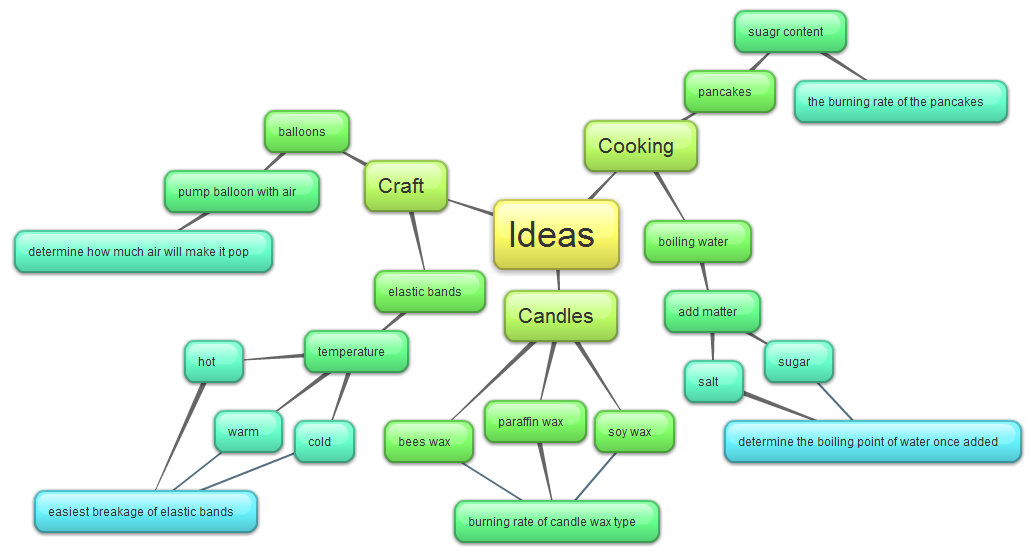
Final Idea- Candle wax
I have finally thought of my final idea. It's going to be an experiment on which type of candle wax burns the fastest. I am going to conduct this experiment by buying 3 candles, each different types of candle wax.
I'll measure the height of each candle in centimetres, and make sure each are the same size. Then I'll light each candle, and let them burn for an hour.
Once and hour is up, I'll tip out the melted wax into a bowl and weigh the wax extracted from each candle, then measure the height of each candle and record my results in a table.
This will then be repeated 3 times over, or I'll buy 3 of each type of candle and conduct the experiment all at the same time.
I'll measure the height of each candle in centimetres, and make sure each are the same size. Then I'll light each candle, and let them burn for an hour.
Once and hour is up, I'll tip out the melted wax into a bowl and weigh the wax extracted from each candle, then measure the height of each candle and record my results in a table.
This will then be repeated 3 times over, or I'll buy 3 of each type of candle and conduct the experiment all at the same time.

Monday, 14 March 2011
Still Thinking?
I've been having some second thoughts about the balloon experiment, especially about the practicality and now that I think of it, I don't think it would be quite pleasant to have balloons continuously popping in your face. So I've some other thoughts about possible ideas.
A couple of my other ideas were:
changing the amount of vinegar in toffee to see which toffee batch would set fastest
and, I know the notification says no flammable substances, but I was thinking that if I set different types of nuts on fire and timed how long each nut took to burn out, I could determine which nut has the highest oil content.
The thing is, I asked about the nut experiment, and it isn't going to work, because the nut could be burning not just from its oil content, so i guess I'll have to scratch that idea.
A couple of my other ideas were:
changing the amount of vinegar in toffee to see which toffee batch would set fastest
and, I know the notification says no flammable substances, but I was thinking that if I set different types of nuts on fire and timed how long each nut took to burn out, I could determine which nut has the highest oil content.
The thing is, I asked about the nut experiment, and it isn't going to work, because the nut could be burning not just from its oil content, so i guess I'll have to scratch that idea.
Subscribe to:
Posts (Atom)